OT: - Grammar controversy | Page 3 | The Boneyard

OT: Grammar controversy

It's unclear to me why this is deemed best in an abstract or general sense. These things are situational.

So by this stricture, when I address the fussbudgets (great word, by the way!), rather than asking, “Is this really worth fussing over?” I should say, “Is this something about which it is worthwhile to fuss?”
Fussbudget?

Balderdash!
 
If I may be permitted, allow me to temporarily swerve this thread towards basketball. Shock! Horror! Think of the children...

Can anyone explain why commentators have dropped the "up" from "lay-up"? We now have players making or, too frequently, missing "lays".

The second is the disappearance of the set shot, where a player shoots with their feet on the floor. It seems that they are all called jump shots, even if the height of the jump is zero. To see a true jump shot look no further than Paige who jumps high and releases the ball above head height. Stewie also has a great, real, jump shot that is almost unguardable for mere humans.

I know the language evolves, but these have me scratching my head!
 
By the end of the century, English is likely to lose the accusative (already less than 10 pronouns), subjunctive (already mostly vanished
except was/were), and the apostrophe.

The split infinitive rule is nonsense, an attempt to apply Latin grammar (where the infinitive is one word) to English.

Some of what look like sentence-ending prepositions are actually part of compound verbs: "I asked him to come back."
 
.-.
By the end of the century, English is likely to lose the accusative (already less than 10 pronouns), subjunctive (already mostly vanished
except was/were), and the apostrophe.

The split infinitive rule is nonsense, an attempt to apply Latin grammar (where the infinitive is one word) to English.

Some of what look like sentence-ending prepositions are actually part of compound verbs: "I asked him to come back."
And the rule that it should be "fewer than 10 pronouns" as the pronouns are countable, with less being for non-countable?

And let's not start on the subjunctive! :) Oh, rats... It was already discussed above. And I think I put in my 2 cents' worth :(
 
By the end of the century, English is likely to lose the accusative (already less than 10 pronouns), subjunctive (already mostly vanished
except was/were), and the apostrophe.
By the accusative pronouns you mean that “me”, ”him”, ”us” etc. are forecast for extinction? Which pronouns would take their place, the nominative?
 
Some of what look like sentence-ending prepositions are actually part of compound verbs: "I asked him to come back."
We agree, though our nomenclature varies. I would say phrasal verbs instead of compound verbs. They are the same thing with different labels.

A phrasal verb, for those who give a damn, yeah, both of you, includes a verb and one or more particles. Take, for example, Rocky's motto, “Don't look up!”. Look is the verb, and up is the particle, though it can be an adverb, an adjective, or a preposition in other circumstances.

If some grumpy fuddy duddy complains that the motto ends a sentence with a preposition, do what Rocky (@RockyMTblue2) does. Ignore them. You may also wish to suggest that they do (note the subjunctive there) something anatomically difficult. Finally, please tell them to learn a little bit about grammar. For a coda, ask what authority they wish to cite when declaring something to be against the “rules”. Who are the rulemakers, and why are they so ignorant?

The so-called rule makers are buffoons we may look down on. “Look down on” is a phrasal verb. Feel free to use it in a sentence: Lovers of prescriptive grammar and proscriptive grammar are folks we look down on. Clowns who inveigh against terminal prepositions are the sort of pompous turkeys we don't have to put up with.

{/rant}
 
Last edited:
And poppycock, my grandmother's favorite.
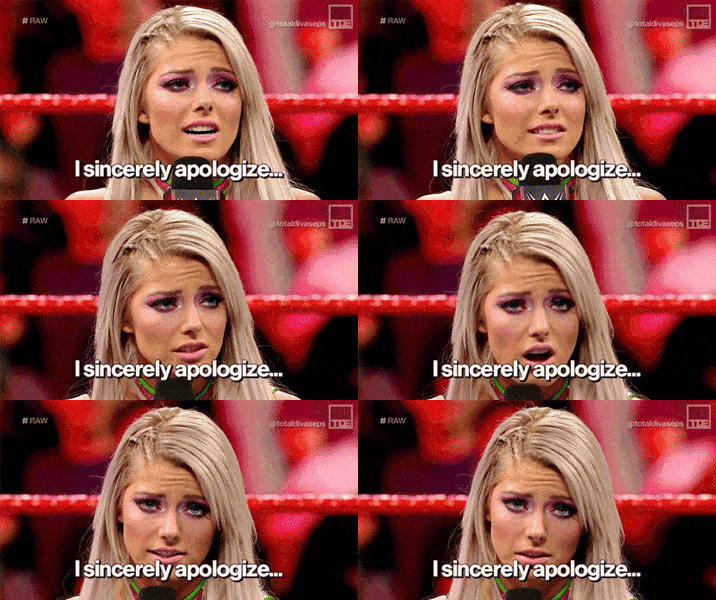
Was her nickname for your grandfather "Poppy"?

Apology Reaction GIF by MOODMAN
 
By the accusative pronouns you mean that “me”, ”him”, ”us” etc. are forecast for extinction? Which pronouns would take their place, the nominative?
Yes. English long ago abandoned the accusative form of nouns. Many people don't bother to use whom, and the other personal pronouns are likely to eventually follow. English largely uses word order where other languages use case markings: "I gave John the book", where syntax puts John in dative and book in accusative.
 
The distinction between less and fewer is entirely artificial and most languages don't recognize it.
 
.-.
Yes. English long ago abandoned the accusative form of nouns. Many people don't bother to use whom, and the other personal pronouns are likely to eventually follow. English largely uses word order where other languages use case markings: "I gave John the book", where syntax puts John in dative and book in accusative.
So we will soon be saying, “He gave I the book” and “Don't talk to I like that”? Interesting. I'd argue this is different than the atrophy of “whom” but who's to say.
 
The distinction between less and fewer is entirely artificial and most languages don't recognize it.
Artifical is highly subjective in this context as fewer is for countables, while less is for uncountables.
 
Fewer versus less is a debate in English grammar about the appropriate use of these two determiners. Linguistic prescriptivists usually say that fewer and not less should be used with countable nouns,[2] and that less should be used only with uncountable nouns. This distinction was first tentatively suggested by the grammarian Robert Baker in 1770,[3][1] and it was eventually presented as a rule by many grammarians since then.[a] However, modern linguistics has shown that idiomatic past and current usage consists of the word less with both countable nouns and uncountable nouns so that the traditional rule for the use of the word fewer stands, but not the traditional rule for the use of the word less.[3] As Merriam-Webster's Dictionary of English Usage explains, "Less refers to quantity or amount among things that are measured and to number among things that are counted."

The Cambridge Guide to English Usage notes that the "pressure to substitute fewer for less seems to have developed out of all proportion to the ambiguity it may provide in noun phrases like less promising results". It describes conformance with this pressure as a shibboleth and the choice "between the more formal fewer and the more spontaneous less" as a stylistic choice.” “

source:

As with many so-called rules, if enough self-styled experts proclaim loudly for a long while, and ignore the way native speakers actually use the language, we have these debates.

IMG_2924.jpeg
 
Artifical is highly subjective in this context as fewer is for countables, while less is for uncountables.
Is furniture countable or uncountable? It logically should be countable, but the noun (for no fathomable reason) is in the form of an uncountable.

If the distinction were real and important, there would be two different forms of more.
 
Fewer versus less is a debate in English grammar about the appropriate use of these two determiners. Linguistic prescriptivists usually say that fewer and not less should be used with countable nouns,[2] and that less should be used only with uncountable nouns. This distinction was first tentatively suggested by the grammarian Robert Baker in 1770,[3][1] and it was eventually presented as a rule by many grammarians since then.[a] However, modern linguistics has shown that idiomatic past and current usage consists of the word less with both countable nouns and uncountable nouns so that the traditional rule for the use of the word fewer stands, but not the traditional rule for the use of the word less.[3] As Merriam-Webster's Dictionary of English Usage explains, "Less refers to quantity or amount among things that are measured and to number among things that are counted."

The Cambridge Guide to English Usage notes that the "pressure to substitute fewer for less seems to have developed out of all proportion to the ambiguity it may provide in noun phrases like less promising results". It describes conformance with this pressure as a shibboleth and the choice "between the more formal fewer and the more spontaneous less" as a stylistic choice.” “

source:

As with many so-called rules, if enough self-styled experts proclaim loudly for a long while, and ignore the way native speakers actually use the language, we have these debates.

View attachment 110266

No! Now the discussion will turn to the grocer's apostrophe!!


And the second sentence h that article references another of my pet hates: diffuse/defuse. And don't get me started on people conflating imply and infer...

BTW, I come from a country where we use, to the most part, the King's English (the language formerly known as the Queen's English). When I was in the States people often though I was English*, although I live almost as far as physically possible from the Mother Country!

* Apparently a US student expressed surprise that people in the UK spoke English. She said "I thought they would have their own language."
 
No! Now the discussion will turn to the grocer's apostrophe!!
Ah! The Guardian. As a (presumed) Commonwealth citizen, you are doubtless aware of its common sobriquet, “ The Grauniad”. There is certain irony to a journal famed for spelling indiscretions writing about greengrocers and their superfluous marks. Or is that marx, as in Harpo?

As to the US student's hopelessly ignorant remark, people in the U.K. speak RP, and hundreds of local variants of English, Welsh, Gaelic, Scottish, etc. The notion that any one dialect of English is more correct than others is patently false. Of course my spouse, a native BE (British English) speaker, frequently reminds me that my colonial dialect is not quite so good as what's spoken across the puddle.
IMG_2926.jpeg
 
.-.
Ah! The Guardian. As a (presumed) Commonwealth citizen, you are doubtless aware of its common sobriquet, “ The Grauniad”. There is certain irony to a journal famed for spelling indiscretions writing about greengrocers and their superfluous marks. Or is that marx, as in Harpo?

Ah yes, I believe it was Private Eye that coined that name. At least the Grauniad exhibits typical British self-deprecating humour, in that they're not afraid to make fun of themselves:


I had an interesting discussion with a USAian a while back regarding space shuttle names: Endeavour is spelled the British way as it was named after one of James Cook's ships. He visited our islands during his explorations.

I'm unrepentantly unilingual, while my spouse has English as her third language, although the second has largely atrophied through lack of use.

I'm tempted to hijack this thread into a discussion of mispronunciation. It appears that the rule of silent 'e' has been repealed in the US. Refer to this gem from Tom Lehrer:


My kids grew up watching Sesame Street, so I spent a lot of time correcting their pronunciation - including 'Z' as "zed" not "zee"!
 
From Cheers. Sam to Diane ‘don’t you have customers to deal with?’; Diane ‘you just ended a sentence with a preposition’; Sam ‘don’t you have customers to deal with, mullethead?’
 
A wise and thoughtful gent who used to post prolifically here sent me a link to a wapo article about the decline of the semicolon. Out of a lack of respect for the tacky publisher, my subscription has lapsed. I make no promises about the accessibility of the link.


I confess to using semicolons now and then. They serve a purpose; in fact, they serve a few.
 
I confess to using semicolons now and then. They serve a purpose; in fact, they serve a few.
I see what you did there.

Back in the day before all the graphical nonsense, when real Internet users had ASCII only, they were used to make a winking emoticon - ;-)
 
Last edited:
There's a new documentary out about a grammarian called "Rebel with a Clause." There was a spot about the film and its subject, Ellen Jovin, on Here & Now yesterday. For some years, she's been going to different cities and setting up a little "Grammar Table."

 
.-.
Many prepositions can also be other parts of speech.(by, down, in........).
 

Forum statistics

Threads
168,009
Messages
4,549,245
Members
10,431
Latest member
TeganK


Top Bottom
