Bracketology - week of Mar 2 thru 15 | Page 4 | The Boneyard

Bracketology - week of Mar 2 thru 15

The NCAA announced the 16 sub-regional host sites:

The 16 teams that will host are, in alphabetical order: Duke, Iowa, Louisville, LSU, Michigan, Minnesota, North Carolina, Ohio State, Oklahoma, South Carolina, TCU, Texas, UCLA, UConn, Vanderbilt and West Virginia.

 
The NCAA announced the 16 sub-regional host sites:

The 16 teams that will host are, in alphabetical order: Duke, Iowa, Louisville, LSU, Michigan, Minnesota, North Carolina, Ohio State, Oklahoma, South Carolina, TCU, Texas, UCLA, UConn, Vanderbilt and West Virginia.

Minny and Michigan are hosting. Love it!! Let's pack the Barn!!
Dave Chappelle Prince GIF
 
Who can tell me why Creme has Oklahoma paired with fellow SEC team Texas? Why wouldn't WVU and Oklahoma be switched?
Are you referring to the rule:
"By bracketing rules, the first four teams from a conference must be placed in different regions."

If so, South Carolina, Texas, LSU and Vanderbilt the first four teams from the SEC and are in different regions. Oklahoma is the fifth team from that conference.
 
2026 WCBB NCAAT Bracketology Teams by Overall Seeding:
  • Number in () is the NET on the day on/before the Bracketology date.
  • AQ next to Conference Affiliation means “Automatic Qualifier” for a Conference.
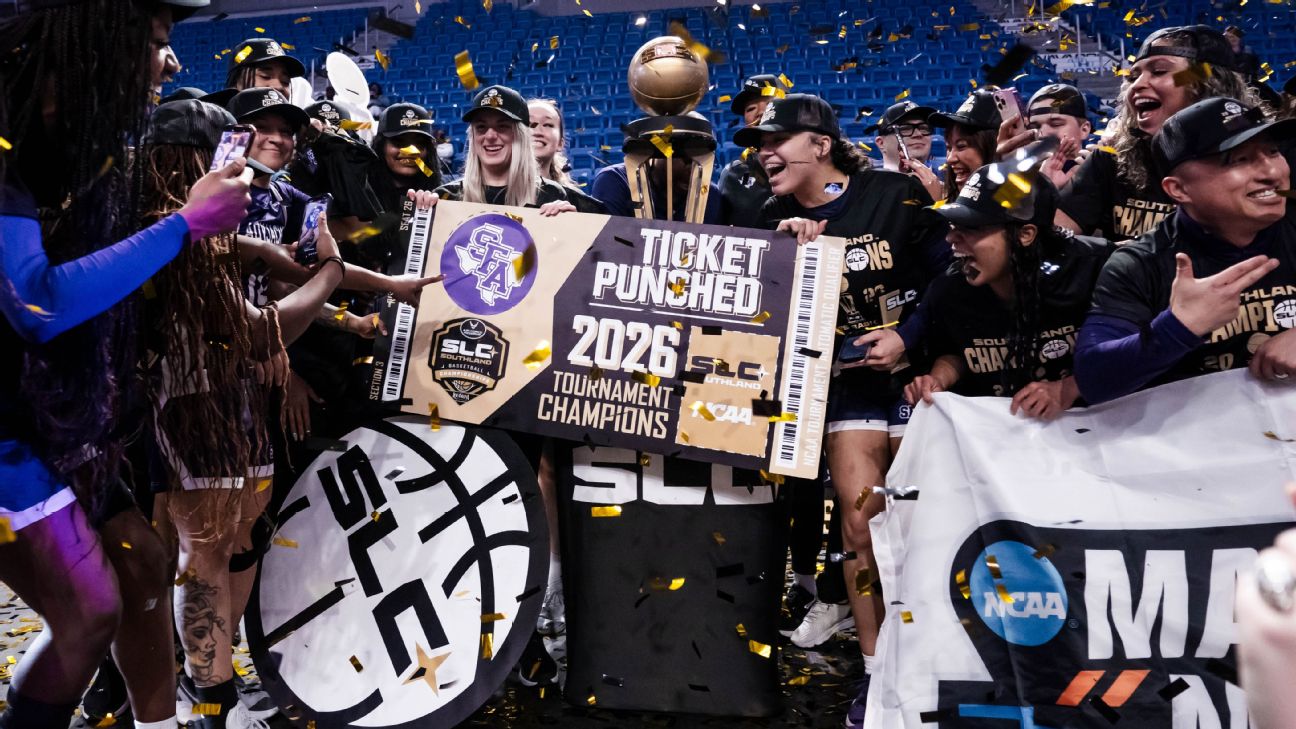
  • AQ next to team name means that team has “punched its ticket” as an actual Auto Qualifier.
IMG_0300.jpeg
 
.-.
NCAA Dashboard (3/14/2026) appended to ESPN Bracketology (3/14/2026) to provide insight on:
  • (a) the Hypothesis Testing continuum of the 37 At-Large (Type &1 = 2) Qualifiers;
  • (b) the 68-team Bracketed S-Curve (Overall Seed (OSeed)).
The NCAA procedures for (a), S-Curve and (b) are here.

&1 Type = 1 (Automatic Qualifier) and 2 (At-large Qualifier). “AQ” next to team name means that team has “punched its ticket” as an actual Auto Qualifier.

IMG_0298.jpeg


Top 20 Overall Seed | Remaining Schedule
By Conference Bids: Conference Standings | Conference Tournaments

IMG_0299.jpeg
 
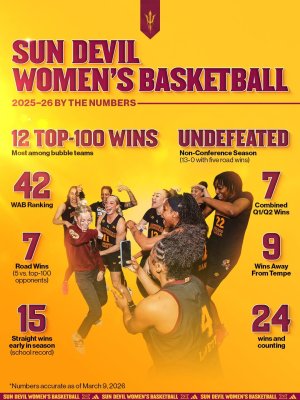
The last ESPN bracketology head ASU as one of the last four in playing Virginia in Norman Oklahoma... a 16 hour drive from Flagstaff

Let's hope that holds. And like all fans I'm super demanding I would love to see iASU play Nebraska in LA... The closest site for me.
 
Heard something interesting in the men's bracket Selection Show which I had not heard before; the overall #5 seed cannot be paired with the overall #1 seed; that would imply it is regardless of those other intra-conference rules we've been discussing here for days.

Don't believe I've heard that rule mentioned as applicable in the women's tourney guidelines.
 
Heard something interesting in the men's bracket Selection Show which I had not heard before; the overall #5 seed cannot be paired with the overall #1 seed; that would imply it is regardless of those other intra-conference rules we've been discussing here for days.

Don't believe I've heard that rule mentioned as applicable in the women's tourney guidelines.
I agree, I haven't heard that restriction. In theory there is nothing that absolutely requires men's and women's rules have to be identical, but it's been my impression that they were largely in sync.

One thing I've been thinking about a lot lately is that the intra-conference restrictions have always been a minor annoyance, but with the conference realignment, the biggest conferences are getting even more teams in and that makes those rules come into play more often.

It occurred to me that I have a sense of the distribution of teams for the women but not so much for the men so I looked it up for the top two conferences:

Women
Big Ten 12, SEC 10

Men
SEC 14 Big Ten 8

Interesting to see that while for the men it's much more heavily weighted to the SEC, in both cases there are 22 teams in the top two conferences. Of course, the major restrictions apply to the top four seeds and I checked how that compares men versus women, but we are definitely seeing a number of situations where teams have to be moved from the natural S-curve location, either changing seed lines or changing venue which affects who can play whom. I won't be surprised if we run into a situation where the rules are impossible to meet and/or they have to invoke a meta rule which tells him what to do when rules collide.

I won't be surprised if this in history in the rule you mentioned – I'm betting there was a circumstance where either the selection committee had the number one versus the number five overall, and the feedback resulted in a rule that they would never do that again, or was an early proposal and slapped down.
 
I agree, I haven't heard that restriction. In theory there is nothing that absolutely requires men's and women's rules have to be identical, but it's been my impression that they were largely in sync.

One thing I've been thinking about a lot lately is that the intra-conference restrictions have always been a minor annoyance, but with the conference realignment, the biggest conferences are getting even more teams in and that makes those rules come into play more often.

It occurred to me that I have a sense of the distribution of teams for the women but not so much for the men so I looked it up for the top two conferences:

Women
Big Ten 12, SEC 10

Men
SEC 14 Big Ten 8

Interesting to see that while for the men it's much more heavily weighted to the SEC, in both cases there are 22 teams in the top two conferences. Of course, the major restrictions apply to the top four seeds and I checked how that compares men versus women, but we are definitely seeing a number of situations where teams have to be moved from the natural S-curve location, either changing seed lines or changing venue which affects who can play whom. I won't be surprised if we run into a situation where the rules are impossible to meet and/or they have to invoke a meta rule which tells him what to do when rules collide.

I won't be surprised if this in history in the rule you mentioned – I'm betting there was a circumstance where either the selection committee had the number one versus the number five overall, and the feedback resulted in a rule that they would never do that again, or was an early proposal and slapped down.

It is really tough to keep up with the frequent rule changes. To me, it seems like the women's bracketology rules eventually catch up to the men's bracketology rules, but it may take a year or two to adopt them.

I thought the men's team had a rule which tried to keep the Top 16 teams in their "natural" geographic region as long as the bracket was "balanced" and avoided those intra-conference pairings. Obviously, the men still have four regionals, while the women only have two regionals. So, a 2-seed Houston gets to be placed in the hometown Houston Regional opposite 1-see Florida advantage 2-seed. Similarly, 2-seed UConn gets to be placed in the Philadelphia Regional opposite 1-seed Duke. And, it even worked out for 2-seed Iowa State being placed in the St. Louis Regional opposite 1-seed Michigan; advantage 2-seed.
 
Here are Creme's results from his last projection vs the official bracket:

Seed and region - 18
Seed only - 24
Seed guessed too high - 16
Seed guessed too low - 6
 
.-.

Forum statistics

Threads
167,748
Messages
4,537,482
Members
10,413
Latest member
Sec202


Top Bottom