So... What if Texas wanted in the Big Ten and compensated B1G for appearances on LHN? | Page 2 | The Boneyard

So... What if Texas wanted in the Big Ten and compensated B1G for appearances on LHN?

Status
Not open for further replies.
Oklahoma offers more to the B1G than Nebraska, and the B1G welcomed them. Suppose UConn and Va Tech come in first ... then Kansas and Oklahoma are available. Don't you think the B1G will offer?

A lot here depends on who becomes available when.
I think you are spot on... "A lot here depends on who becomes available when." Nevertheless, you know the score: B1G wants UVA, not Va Tech. B1G wants UNC, not NCS, Kansas not KS. The math is not complex - no disrespect intended. B1G wants flagship / AAU schools first and foremost. (Sizable market is desirable.) Texas would be fine but is completely geo removed from current footprint. That would be the one and only reason OK gets a pass - fill in the gap between Tex and Kansas / Neb. Kansas doesn't need a pass. Big egos to feed in the B1G, don't ya know...
 
I'm a very strong believer that the Big Ten would take both Kansas and Oklahoma if they're available *alone*. The catch is the *alone* part. Kansas and Oklahoma may not be able to come alone because they're in the position of "big brother" to Kansas State and Oklahoma State

I would agree as both add value to the B1G in terms of football (Oklahoma) and basketball (Kansas) content while also serving other key metrics as state flagship universities (both Oklahoma and Kansas), AAU (Kansas), and would provide a contiguous land bridge from Nebraska to potentially Texas.

In retrospect though, I think that the B1G made a mistake not taking Missouri now. Missouri is AAU, is culturally similar to the B1G (more so than the SEC), provides decent basketball and football, access to a decent KC market while sealing off the St Louis market to everyone else Missouri was very interested. Should have added Missouri and Maryland in 2014/5 and told Rutgers and hopefully UConn that each had 5 years to impove their programs (UConn football, Rutgers everything), facilities, and academics (UConn to AAU) before joining. That would have sealed the NYC market for the B1G with access to Philadelphia and Boston also while leaving 4 remaining slots open for either UVA/UNC/G Tech/Florida St or Kansas/Oklahoma/Texas/+1 to get to 20 down the road.

As for Oklahoma St and Kansas St, I agree that it is an issue; but, I suspect that each state will decide not to sink their respective flagship universities just to try and save their secondary school. While protected from being raided itself, geography also limits the PAC's expansion options. Thus, if the 'end' game appears and Texas Tech, Kansas St, and Oklahoma St are available; but, their bigger brothers are not, the PAC will take them.
 
The SEC will need two more teams during the next round of expansion. It seems that everyone here is mentioning current Big 12 teams. Why would they not think about possibly stealing two ACC teams. I know that the two Virginia schools are joined at the hip so that may not happen. They could always ask Florida State to join if Gators approve. Or even Clemson, Georgia Tech. Imagine North Carolina jumping ship and joining the SEC. That would rattle the ACC.

Florida St, G Tech and Clemson each have a barrier to entry to the SEC with U Florida, U Georgia, and U South Carolina respectively. Plus, while the ACC has issues, the XII is more unstable due to the weight of U Texas and not major issues surrounding future access to the Football Playoff without a championship game.

In an ideal world, the XII implodes and the B1G, SEC, and the ACC trade whereby West Virginia goes to the ACC to replace Louisville who goes to the SEC, replacing Missouri which goes to the B1G. The SEC then raids U Miami realizing that state can support 2 programs (if Mississippi can support 2 SEC teams, so can Florida). Cincinnati then replaces U Miami in the ACC. The final add for the SEC would be the better of TCU and Balyor as texas can also easily support 2 SEC teams and each would be less of a threat to Texas A&M than U Texas would be and would not demand any special treatment. Alternatively, maybe the SEC would look at K State and OK St assuming Oklahoma and Kansas each left for the B1G as the two states do offer decent football?
 
Florida St, G Tech and Clemson each have a barrier to entry to the SEC with U Florida, U Georgia, and U South Carolina respectively. Plus, while the ACC has issues, the XII is more unstable due to the weight of U Texas and not major issues surrounding future access to the Football Playoff without a championship game.

In an ideal world, the XII implodes and the B1G, SEC, and the ACC trade whereby West Virginia goes to the ACC to replace Louisville who goes to the SEC, replacing Missouri which goes to the B1G. The SEC then raids U Miami realizing that state can support 2 programs (if Mississippi can support 2 SEC teams, so can Florida). Cincinnati then replaces U Miami in the ACC. The final add for the SEC would be the better of TCU and Balyor as texas can also easily support 2 SEC teams and each would be less of a threat to Texas A&M than U Texas would be and would not demand any special treatment. Alternatively, maybe the SEC would look at K State and OK St assuming Oklahoma and Kansas each left for the B1G as the two states do offer decent football?
If I got all that, it would leave B1G with 17 schools. That might be a problem... or is my math poor?
 
I would agree as both add value to the B1G in terms of football (Oklahoma) and basketball (Kansas) content while also serving other key metrics as state flagship universities (both Oklahoma and Kansas), AAU (Kansas), and would provide a contiguous land bridge from Nebraska to potentially Texas.

In retrospect though, I think that the B1G made a mistake not taking Missouri now. Missouri is AAU, is culturally similar to the B1G (more so than the SEC), provides decent basketball and football, access to a decent KC market while sealing off the St Louis market to everyone else Missouri was very interested. Should have added Missouri and Maryland in 2014/5 and told Rutgers and hopefully UConn that each had 5 years to impove their programs (UConn football, Rutgers everything), facilities, and academics (UConn to AAU) before joining. That would have sealed the NYC market for the B1G with access to Philadelphia and Boston also while leaving 4 remaining slots open for either UVA/UNC/G Tech/Florida St or Kansas/Oklahoma/Texas/+1 to get to 20 down the road.

As for Oklahoma St and Kansas St, I agree that it is an issue; but, I suspect that each state will decide not to sink their respective flagship universities just to try and save their secondary school. While protected from being raided itself, geography also limits the PAC's expansion options. Thus, if the 'end' game appears and Texas Tech, Kansas St, and Oklahoma St are available; but, their bigger brothers are not, the PAC will take them.

They had to decide on Missouri before Maryland was available. So in your scenario it would have been Missouri and Rutgers in 2012 and then Maryland and UConn in 2014. Obviously, Maryland was perceived as having more value than Missouri ... also the TV market changed in the intervening two years.
 
The SEC will need two more teams during the next round of expansion. It seems that everyone here is mentioning current Big 12 teams. Why would they not think about possibly stealing two ACC teams. I know that the two Virginia schools are joined at the hip so that may not happen. They could always ask Florida State to join if Gators approve. Or even Clemson, Georgia Tech. Imagine North Carolina jumping ship and joining the SEC. That would rattle the ACC.

I think the only way The SEC takes a school from The ACC is if The ACC was breaking up. Taking UNC from The ACC would severely damage the conference. Since ESPN has almost al of both The ACC and The SEC media rights (CBS does own 1 SEC football game per week). Unless ESPN thinks it can make more money with UNC in The SEC and a fractured ACC, what is the incentive for ESPN to pay? That's not taking into account UNC desire to remain in The ACC with Duke and UVA.

The only other school that would make since is VT. I just don't see UVA as an SEC school. They value academics too much to leave The ACC for an inferior academic conference. I think UVA wants to stay in The ACC with The Big10 has a last resort backup (The ACC collapsing). VT might go, but I think they are happy in The ACC. I think they have more in common with The Big10. Schools like UMD and PSU would be natural geographic rivals and VT research is improving.

The other southern ACC schools are all redundant. Clemson, GTI, and FSU are all in the existing footprint and would have a hard time paying for themselves.
 
.-.
In retrospect though, I think that the B1G made a mistake not taking Missouri now. Missouri is AAU, is culturally similar to the B1G (more so than the SEC), provides decent basketball and football, access to a decent KC market while sealing off the St Louis market to everyone else Missouri was very interested. Should have added Missouri and Maryland in 2014/5 and told Rutgers and hopefully UConn that each had 5 years to impove their programs (UConn football, Rutgers everything), facilities, and academics (UConn to AAU) before joining. That would have sealed the NYC market for the B1G with access to Philadelphia and Boston also while leaving 4 remaining slots open for either UVA/UNC/G Tech/Florida St or Kansas/Oklahoma/Texas/+1 to get to 20 down the road.

Disagree completely about Mizzou. Nebraska was a much greater add than Mizzou was. Remember, Mizzou joined The SEC in July 2012, 4 months before news broke about UMD and Rutgers. Unless Mizzou was/is willing to leave The SEC (I don't think they are) they were not in play in 2014.

Academically and market wise, Rutgers and UMD were the correct move. Getting a foot in the door in both NYC with the AAU standing (to go along with the new medical center). Being contiguous with Pennsylvania was a huge plus as Delany wants that "bridge" to The NE.

I think UConn is very much in The Big10's plans. They will cap off the NYC market (which I don't believe would be complete without both Rutgers and UConn). As mentioned above, Delany has consistently talked about Rutgers and UMD being bridges their respective areas. It's obvious UMD is a bridge to Virginia and NC. Wh0 is Rutgers a bridge to? Buffalo? A hockey school? My guess is UConn and The NE.
 
I would agree as both add value to the B1G in terms of football (Oklahoma) and basketball (Kansas) content while also serving other key metrics as state flagship universities (both Oklahoma and Kansas), AAU (Kansas), and would provide a contiguous land bridge from Nebraska to potentially Texas.

In retrospect though, I think that the B1G made a mistake not taking Missouri now. Missouri is AAU, is culturally similar to the B1G (more so than the SEC), provides decent basketball and football, access to a decent KC market while sealing off the St Louis market to everyone else Missouri was very interested. Should have added Missouri and Maryland in 2014/5 and told Rutgers and hopefully UConn that each had 5 years to impove their programs (UConn football, Rutgers everything), facilities, and academics (UConn to AAU) before joining. That would have sealed the NYC market for the B1G with access to Philadelphia and Boston also while leaving 4 remaining slots open for either UVA/UNC/G Tech/Florida St or Kansas/Oklahoma/Texas/+1 to get to 20 down the road.

As for Oklahoma St and Kansas St, I agree that it is an issue; but, I suspect that each state will decide not to sink their respective flagship universities just to try and save their secondary school. While protected from being raided itself, geography also limits the PAC's expansion options. Thus, if the 'end' game appears and Texas Tech, Kansas St, and Oklahoma St are available; but, their bigger brothers are not, the PAC will take them.

I get the Rutgers' disses, but only so far.

NJ is a damn fine prep football state that seems to be cranking out greater talent each year - it seems to be creeping towards top 10, nationwide, and that's just too hard to pass up in terms of recruiting footprint. Jersey prep football could become the Ohio of the Northeast. They are also a very good prep basketball state.

Rutgers had a nice bowl record under Schiano and they beat some decent P5 programs in that run. The current coach is suspect, but his bowl game performances have been ok - blowout of UNCheat, close & very winnable game against VT, and an ugly loss to ND.

They've put a lot of good to even great players in the NFL & most of these players are Jersey natives.

Rutgers is a very good research school, esp graduate level - many, many programs (that's money man). It's simply one of those universities that will never lose certain credentials, such as AAU, but only move forward.

Nearly 9 million people in NJ.

Rutger's is the sole flagship of NJ.

Upside with Rutgers is definitely there. We tend to forget, Rutgers has only been in the big time for a couple of decades - sure some of this delay is their fault, but now they have an opportunity & I have a sneaking suspicion they'll be pretty good at football and basketball in a couple of decades - not UConn good in hoops, not OSU good in football. But they can have a balance similar to Wisconsin or Oregon. Remember, neither Oregon nor Wisconsin have won a football NC (Oregon's come closer than Wisky, obviously), and neither have Jersey level prep football-basketball, not even close. They must mine California - must. Wisconsin prep football is no better than Oregon's - they've increasingly gone national in recruiting.
 
I get the Rutgers' disses, but only so far.

NJ is a damn fine prep football state that seems to be cranking out greater talent each year - it seems to be creeping towards top 10, nationwide, and that's just too hard to pass up in terms of recruiting footprint. Jersey prep football could become the Ohio of the Northeast. They are also a very good prep basketball state.

Rutgers had a nice bowl record under Schiano and they beat some decent P5 programs in that run. The current coach is suspect, but his bowl game performances have been ok - blowout of UNCheat, close & very winnable game against VT, and an ugly loss to ND.

They've put a lot of good to even great players in the NFL & most of these players are Jersey natives.

Rutgers is a very good research school, esp graduate level - many, many programs (that's money man). It's simply one of those universities that will never lose certain credentials, such as AAU, but only move forward.

Nearly 9 million people in NJ.

Rutger's is the sole flagship of NJ.

Upside with Rutgers is definitely there. We tend to forget, Rutgers has only been in the big time for a couple of decades - sure some of this delay is their fault, but now they have an opportunity & I have a sneaking suspicion they'll be pretty good at football and basketball in a couple of decades - not UConn good in hoops, not OSU good in football. But they can have a balance similar to Wisconsin or Oregon. Remember, neither Oregon nor Wisconsin have won a football NC (Oregon's come closer than Wisky, obviously), and neither have Jersey level prep football-basketball, not even close. They must mine California - must. Wisconsin prep football is no better than Oregon's - they've increasingly gone national in recruiting.

No disrespect indented at Rutgers. Simply stated, outside of the Big E, their only landing spot would have been the ACC and the ACC showed their lack of insight by taking Syracuse over Rutgers in the prior go-round. In 5 years, Rutgers likely would still be in the old Big E or American and would have time to start to upgrade their facilities, which outside of the football stadium itself, are well behind B1G in most areas, and their non-football programs.
 
If I got all that, it would leave B1G with 17 schools. That might be a problem... or is my math poor?

I suspect that the B1G is targeting 20 as the number it wants to be at. Assuming the XII is the conference that folds, this outline would jump the B1G from 14 programs today to 15) Missouri, 16) Kansas, 17) Oklahoma, 18) U Texas, 19) UConn (I hope), and one TBD slot for 20.
 
The suggestion that the Big Ten operates like the SEC when it comes to distribution of revenue is totally inaccurate. The Big Ten has a 7 year integration period, longer than any other conference. Rutgers and Marlyand won't become full partners until the 2020-2021 season. In fact, the integration teams, including Nebraska, won't see any of the incremental revenue from Ohio State's Semi-Final Game. See Link below.

http://www.nj.com/rutgersfootball/i..._state_playing_for_national_championship.html

The SEC started handing out equal shares to its new members in their first year. The PAC 12 started Colorado as an equal partner and Utah has a three-year integration plan. Texas aside, the Big 12 has West Virginia on a four-year integration plan. While the revenue in the ACC is somewhat tiered, they start out new members with "fullish" shares. The Big Ten is still the optimum conference for UConn, which would readily endure a 7 year integration plan, with a smile on its face, but so suggest the B1G operates like the SEC is not just accurate. In fact, they are pretty much on the other end of the spectrum.
7 years of indentured service :):):):):):):)
 
I suspect that the B1G is targeting 20 as the number it wants to be at. Assuming the XII is the conference that folds, this outline would jump the B1G from 14 programs today to 15) Missouri, 16) Kansas, 17) Oklahoma, 18) U Texas, 19) UConn (I hope), and one TBD slot for 20.

I think the B1G would be happiest at 16 as a number of teams, but if they had the chance to get KU, OU, Texas, and UConn, would take it to reach 18; but 20 is doubtful.

Re your scenario, I think Texas goes independent with affiliations to the ACC for 5 games a year and bowl eligibility like Notre Dame, 5 games per year with Texas and Oklahoma schools, maybe two games per year with SEC schools in a scheduling agreement.

On the B1G side, I don't think they see much value in Missouri if they have Kansas and Illinois delivering the two big markets of St Louis and Kansas City, so if they expect to get Kansas they won't want Missouri, and Missouri is happy in the SEC. I think the value of Kansas and Oklahoma to them is marginally positive and so they'd be invited if available, but the B1G isn't going to push hard to make them available. I think the B1G would really like UVa or Va Tech and UConn for 16, then watch. They would be poised in 2025 to either reach down the east coast if the ACC imploded or reach down the Midwest if the B12 imploded. UNC and Ga Tech in the east, Kansas and Oklahoma in the west for 18.
 
.-.
I think the B1G would be happiest at 16 as a number of teams, but if they had the chance to get KU, OU, Texas, and UConn, would take it to reach 18; but 20 is doubtful.

Re your scenario, I think Texas goes independent with affiliations to the ACC for 5 games a year and bowl eligibility like Notre Dame, 5 games per year with Texas and Oklahoma schools, maybe two games per year with SEC schools in a scheduling agreement.

On the B1G side, I don't think they see much value in Missouri if they have Kansas and Illinois delivering the two big markets of St Louis and Kansas City, so if they expect to get Kansas they won't want Missouri, and Missouri is happy in the SEC. I think the value of Kansas and Oklahoma to them is marginally positive and so they'd be invited if available, but the B1G isn't going to push hard to make them available. I think the B1G would really like UVa or Va Tech and UConn for 16, then watch. They would be poised in 2025 to either reach down the east coast if the ACC imploded or reach down the Midwest if the B12 imploded. UNC and Ga Tech in the east, Kansas and Oklahoma in the west for 18.

From what I read a while back, 18 maybe difficult from a scheduling aspect, at least for football, as one would basically have to split into two divisions of 9. That means under current NCA rules, every team has 8 locked into interdivisional games leaving 1 cross-division game as all schools will typically want 2 to 3 open slots for non-conference games. Going to 20 (same applies 16), a conference for football can divide into 4 pods of 5. That's 4 interdivisional games, 3 rotating cross-divisional games (1 for each pod), 1 fixed non-divisional 'rival' game, and 1 flex game (semi-final game for each pod leader, pairs for all other teams). That leaves 2 open non-conference slots and a conference title game. Of course, the NCAA may change those requirements in the near future.
 
I suspect that the B1G is targeting 20 as the number it wants to be at. Assuming the XII is the conference that folds, this outline would jump the B1G from 14 programs today to 15) Missouri, 16) Kansas, 17) Oklahoma, 18) U Texas, 19) UConn (I hope), and one TBD slot for 20.

I used to think it was 20 as well, but I now think the magic number is a big question mark. If the ACC plan of eliminating the requirement of everyone within a division playing each other gets voted in, it would make scheduling much easier. With a lowered requirement for a CCG, there are numerous ways this could go. A simple way would be bringing in four schools. Let's say that The Big10 brings in UConn, Kansas, Oklahoma, and eastern school (VT, just as a plugin). They could play six divisional opponents and three crossovers.

Divisions would be ( Bolded teams are the three anchors)

East: UConn, Indiana, UMD, Michigan, MSU, OSU, PSU, Rutgers, VT

West: Illinois, Iowa, Kansas, Minnesota, Nebraska, Northwestern, Oklahoma, Purdue, Wisconsin

Michigan's 9 game conference schedule might look like this:

Divisional - OSU, MSU, UConn, Maryland, Indiana, Rutgers (not playing PSU, VT)
Crossover - Oklahoma, Minnesota (gotta have the game for The Little Brown Jug) and Illinois


UConn's might look like this:

Divisional - PSU, Rutgers, VT, MSU, Michigan, Indiana (Not playing OSU, Maryland)
Crossover - Iowa, Nebraska, Northwestern

(I don't think The Big10 has a chance at UT and Mizzou, but the above four are the best candidates that would want to come to the Big10 if they could).

 
  • Like
Reactions: pj
On the B1G side, I don't think they see much value in Missouri if they have Kansas and Illinois delivering the two big markets of St Louis and Kansas City, so if they expect to get Kansas they won't want Missouri, and Missouri is happy in the SEC. I think the value of Kansas and Oklahoma to them is marginally positive and so they'd be invited if available, but the B1G isn't going to push hard to make them available. I think the B1G would really like UVa or Va Tech and UConn for 16, then watch. They would be poised in 2025 to either reach down the east coast if the ACC imploded or reach down the Midwest if the B12 imploded. UNC and Ga Tech in the east, Kansas and Oklahoma in the west for 18.

I think that you are correct that The Big10 wants to go east and that UConn and UVA/VT are the prime candidates. I think both Kansas and Oklahoma are desired by the Big10. Kansas, much like UConn, would be great for The BTN. Being able to showcase Kansas, Indiana, UConn, and MSU would be huge for ratings and advertisements during the winter months.

As far as Oklahoma goes, they would be awesome for the main media contract. The more games against traditional powers, the more people will watch. Games against Michigan, OSU, PSU, MSU, and Wisconsin would be awesome. That's not even mentioning the renewal of the Oklahoma - Nebraska rivalry. Oklahoma will also get the Big10 into the Dallas market as well.
 
  • Like
Reactions: pj
B1G has a history of going after Flagship / AAU schools. Neb, PSU, MD and Rutgers. Believe we should be informed by this ‘recent’ activity and ask why would future B1G moves deviate significantly from the past? Not many schools fit this B1G ‘profile.’ Would imagine those few who do are targets. Those who do not, well, you know...
 
Last edited:
The SEC will need two more teams during the next round of expansion. It seems that everyone here is mentioning current Big 12 teams. Why would they not think about possibly stealing two ACC teams. I know that the two Virginia schools are joined at the hip so that may not happen. They could always ask Florida State to join if Gators approve. Or even Clemson, Georgia Tech. Imagine North Carolina jumping ship and joining the SEC. That would rattle the ACC.
It's a myth that the Virginia schools are inseparable. The Virginia legislature rescued VaTech. Seeing the writing on the wall about the Big East, they wouldn't let Virginia vote to destroy the league that held another in state school without giving them a safe landing spot. That's different than one of the two schools moving out, if the ACC remains viable, and much, much different than both schools heading to different conferences (Va to the B1G, VaTech to the SEC.) I'm not saying that it's happening. I am saying that the schools were in different conferences for years, and could be again.
 
B1G has a history of going after Flagship / AAU schools. Neb, PSU, MD and Rutgers. Believe we should be informed by this ‘recent’ activity and ask why would future B1G moves deviate significantly from the past? Not many schools fit this B1G ‘profile.’ Would imagine those few who do are targets. Those who do not, well, you know...

Research funding is stagnant and will stay stagnant to declining. That makes the AAU, a lobbying organization, of less significance every year. Meanwhile athletic revenue is rising. They are not going to sacrifice athletic interests to an AAU requirement. It is enough that the schools are "close to AAU" and emphasizing research, i.e. fitting the B1G cultural profile. Both UConn and Va Tech are close to AAU and working to be more like a B1G school research-wise.

The B1G will want public state universities with major fan loyalty throughout the state among non-alumni residents. Virgina Tech would fit that as well as UVa, so it doesn't matter which one is the "flagship".
 
.-.
Contrary to what seems to be popular belief, the SEC is as much of an "everyone shares money equally" conference as the Big Ten. That's one thing that the leagues have in common.

However, I can definitely envision Texas getting a Notre Dame-style deal with the ACC with independence for football and conference membership for all other sports. I'd wager on that before Texas joining the Big Ten or SEC as full members. The LHN is simply unworkable with both the Big Ten and SEC.

On the other hand, one thing that I had underestimated several years ago when I was writing about Texas was that they actually seem to *like* the fact that schools like Texas Tech and Baylor depend upon them. I really thought they truly wanted to get away from their little brothers to be with more of their academic peers, but they clearly have different interests in mind. My analogy was that Texas wants to own a huge ranch and hire worker bees from Lubbock and Waco, whereas Notre Dame just wants everyone to get the duckk off of their lawn. Texas gets a perverse delight from actually controlling an entire conference (not to mention the direct financial benefit of the LHN) that they wouldn't have anywhere else. The Big 12 lives as long as Texas stays... and Texas seems to want to stay.

The LHN is unworkable with the ACC as well. That is unless the only thing Texas would show on it are home football games like Notre Dame does with NBC. The ACC would require the rights to all the non-football programs like it does with Notre Dame, and that would leave the LHN without content. ESPN would have to subsidize the LHN while paying the ACC for Texas content, and I'm not sure they would want to do that.
 
B1G has a history of going after Flagship / AAU schools. Neb, PSU, MD and Rutgers. Believe we should be informed by this ‘recent’ activity and ask why would future B1G moves deviate significantly from the past? Not many schools fit this B1G ‘profile.’ Would imagine those few who do are targets. Those who do not, well, you know...

Is AAU a requirement? If it is, than Nebraska should have never been asked. Michigan and Wisconsin led the charge to get Nebraska removed from the Big10. I highly doubt that the Big10 presidents didn't know they were about to be voted out (a vote was planned the year before and was scrapped because there wasn't enough support). I know there are people who say ". . . but they were AAU when they were invited and accepted." Why would that matter? It's not an NCAA rule or even a Big10 rule as far as we know. So UConn, with their research upgrades (their candidacy has been discussed here) and Oklahoma (not an academic powerhouse, but is a Tier 1 Carnegie school). Both have been vetted by the Big10. Couldn't tell you if their findings support entry, but they have been scrutinized.

As far as VT, they are a very respected school, especially in the STEM fields (#61 according to USNWR) with a great grad research program. Some say that, along with Arizona St and Georgia,they are close to being next in line to be offered a spot in the AAU. They already have great academic relationships with PSU and Maryland. That fits the Big10 profile pretty well. Throw in that hey are bigger, have more students and close to, if not more alumni than UVA with great fan support, they act like a flagship school.

The Big10 wants an East Coast/Mid-Atlantic presence, It seems that, barring a total collapse from the ACC, UVA and UNC are staying put. VT may be willing consider a move. I think that The Big10 would welcome them if UVA said (and like would) say no.
 
The LHN is unworkable with the ACC as well. That is unless the only thing Texas would show on it are home football games like Notre Dame does with NBC. The ACC would require the rights to all the non-football programs like it does with Notre Dame, and that would leave the LHN without content. ESPN would have to subsidize the LHN while paying the ACC for Texas content, and I'm not sure they would want to do that.

I'm not sure it would work that way. My thought is that The LHN would keep whatever ESPN didn't use. ESPN plays Texas basketball games on their non LHN channels. My guess is that would continue as ESPN would own ACC's rights along with Texas'. There would probably be a stipulation for several bb games, but I'm sure The ACC and ESPN would work out that deal. ESPN doesn't show much non football/non basketball content anyway. If an ACC channel came to fruition, my guess is that the LHN would be merged and Texas would be paid at the LHN rate until the deal was up.
 
I'm not sure it would work that way. My thought is that The LHN would keep whatever ESPN didn't use. ESPN plays Texas basketball games on their non LHN channels. My guess is that would continue as ESPN would own ACC's rights along with Texas'. There would probably be a stipulation for several bb games, but I'm sure The ACC and ESPN would work out that deal. ESPN doesn't show much non football/non basketball content anyway. If an ACC channel came to fruition, my guess is that the LHN would be merged and Texas would be paid at the LHN rate until the deal was up.
Ok. If ESPN wanted to create some strategy to merge the two and subsidize both sides until that happens, it could work. The basketball content you're describing today goes to Raycom and ESPN3 for the ACC. In the future, some of it would go onto the ACC Channel if it comes to fruition. If they put it on the LHN, then it would work as long as ESPN makes both parties whole as I mentioned.

But in general I don't know if Texas would want to be a geographic island in the ACC. I would think this would work only if they brought other friends from the Big XII with an ACC going to 18 or 20 members. I don't know that the ACC wants that many members at this point.
 
I wonder about balance between East and West in any B1G expansion. In terms of football you have long term powers Michigan, Ohio State, and Penn State in the East Division. You also have a strong Michigan State program.

In the West you have long term power Nebraska and a strong program in Wisconsin.

I think it would be very hard to convince any of the strong Eastern Division Schools to move West. For balance, Oklahoma would be a great addition.
 
But in general I don't know if Texas would want to be a geographic island in the ACC. I would think this would work only if they brought other friends from the Big XII with an ACC going to 18 or 20 members. I don't know that the ACC wants that many members at this point.

Yeah, I think it would be pretty difficult. That would a pretty big island to deal with. In my opinion, the ACC wants no part of Okie St, KSU, Baylor, TCU, or Iowa St. We know they don't want WVU. I think, if Texas were to go somewhere, it's to either the Pac or Big10.
 
.-.
I wonder about balance between East and West in any B1G expansion. In terms of football you have long term powers Michigan, Ohio State, and Penn State in the East Division. You also have a strong Michigan State program.

In the West you have long term power Nebraska and a strong program in Wisconsin.

I think it would be very hard to convince any of the strong Eastern Division Schools to move West. For balance, Oklahoma would be a great addition.

I think you could get MSU to move. They have always recruited Chicago well and have many alumni in that area. Move Purdue East and MSU west might balance things out somewhat.
 
The LHN is unworkable with the ACC as well. That is unless the only thing Texas would show on it are home football games like Notre Dame does with NBC. The ACC would require the rights to all the non-football programs like it does with Notre Dame, and that would leave the LHN without content. ESPN would have to subsidize the LHN while paying the ACC for Texas content, and I'm not sure they would want to do that.

Nonsense. The reason Notre Dame includes its non-football sports in the ACC ESPN deal is because it has no TV contract for them. Texas has through the LHN its own deal for that content ... so it would carve them out of an ACC deal in the same way it would its football content. That means the ACC would not pay Texas for its content; Texas would market its own content.

The advantage of the deal to the ACC is they own all the home games involving Texas, so they get valuable content. They also please their master ESPN, helping it keep its property away from the B1G or Pac.
 
Research funding is stagnant and will stay stagnant to declining. That makes the AAU, a lobbying organization, of less significance every year. Meanwhile athletic revenue is rising. They are not going to sacrifice athletic interests to an AAU requirement. It is enough that the schools are "close to AAU" and emphasizing research, i.e. fitting the B1G cultural profile. Both UConn and Va Tech are close to AAU and working to be more like a B1G school research-wise.

The B1G will want public state universities with major fan loyalty throughout the state among non-alumni residents. Virgina Tech would fit that as well as UVa, so it doesn't matter which one is the "flagship".
I’m not suggesting you are wrong, but I might need source material before I just accept your statement “Research funding is stagnant and will stay stagnant to declining.” Even with source material, to suggest research funding will stay stagnant to declining requires a willingness to go along with a boat load of assumptions. It is my personal experience the future is pretty hard to see. Also, why would UConn and Va Tech want to be like B1G schools re research? Based on your statement regarding research funding there would be diminishing returns on their investment.

I don’t know if “close to AAU” is good enough. You seem to feel it is and that’s good enough for me, notwithstanding history has indicated otherwise.
 
I’m not suggesting you are wrong, but I might need source material before I just accept your statement “Research funding is stagnant and will stay stagnant to declining.” Even with source material, to suggest research funding will stay stagnant to declining requires a willingness to go along with a boat load of assumptions. It is my personal experience the future is pretty hard to see. Also, why would UConn and Va Tech want to be like B1G schools re research? Based on your statement regarding research funding there would be diminishing returns on their investment.

I don’t know if “close to AAU” is good enough. You seem to feel it is and that’s good enough for me, notwithstanding history has indicated otherwise.

Budget_0.jpg


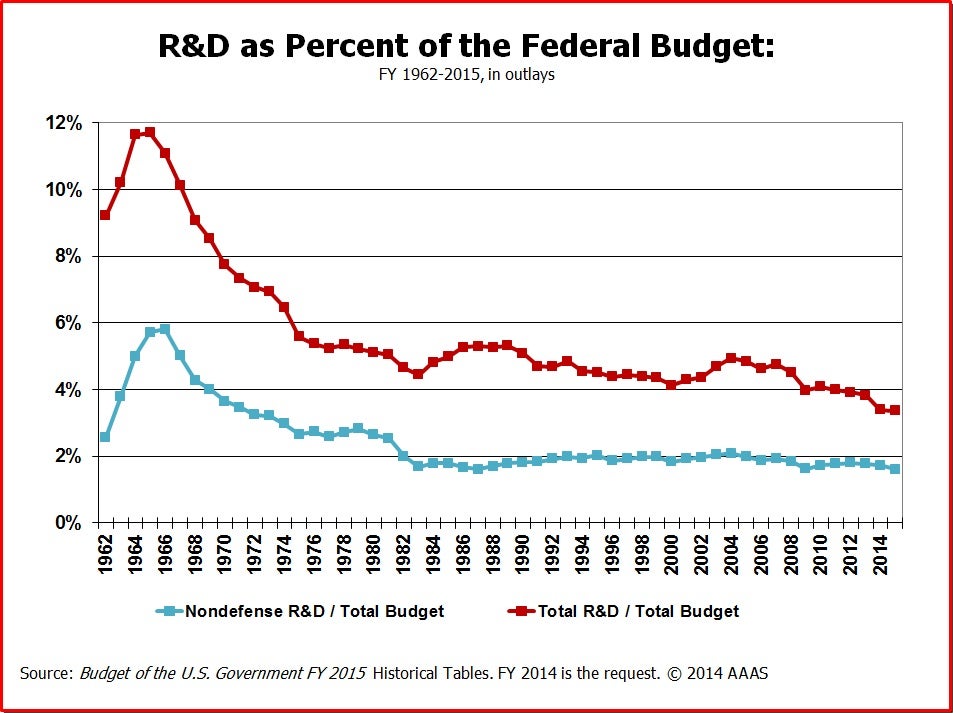
Research funding is falling as a share of the federal budget due to entitlements growing much faster than revenue. Federal budget cannot grow relative to GDP. The economy is not growing fast if at all. Multiple the growth rates together and you get federal research funding topping in absolute dollar amounts and starting to fall.

The peak in federal research funding was in 2011 with stimulus spending. 2014 federal research spending was approximately equal to 2004 spending. It is heading down.
 
This one is a little old and doesn't capture the continued slide or the 2011 stimulus temporary peak, but it shows NIH funding peaking in 2007-8 and basically not growing: This is not corrected for inflation, in real terms the situation is worse.

k_awards_32.jpg
 
Nonsense. The reason Notre Dame includes its non-football sports in the ACC ESPN deal is because it has no TV contract for them. Texas has through the LHN its own deal for that content ... so it would carve them out of an ACC deal in the same way it would its football content. That means the ACC would not pay Texas for its content; Texas would market its own content.

The advantage of the deal to the ACC is they own all the home games involving Texas, so they get valuable content. They also please their master ESPN, helping it keep its property away from the B1G or Pac.

The ACC would do a scheduling alliance with Texas before doing anything like you suggest. There isn't much more to gain if Texas doesn't participate like the rest of the league. And like I mentioned in another post, having 1 Texas school in the ACC creates an island which is not good. I've watched the enthusiasm of all the local West Virginia fans go downhill over the past 3 years over it. They liked travelling to road games, and it is very hard to do that now.

There would be an interest to have 4 or 5 from the Big XII to get to 20 if something like this were to take place creating a whole division in the southwest. And I agree with you that if something like this were to happen ESPN would be orchestrating it.
 
.-.
Status
Not open for further replies.

Forum statistics

Threads
168,336
Messages
4,565,420
Members
10,466
Latest member
agiglax


Top Bottom